Diffusion models have revolutionized generative AI, enabling remarkable advances in generating realistic images, 3D models, audio, and video. However, despite their impressive results, these models are slow at sampling.
We are sharing a new approach, called sCM, which simplifies the theoretical formulation of continuous-time consistency models, allowing us to stabilize and scale their training for large scale datasets. This approach achieves comparable sample quality to leading diffusion models, while using only two sampling steps. We are also sharing our research paper(opens in a new window) to support further progress in this field.
Sampling procedure of consistency models. Sampling time measured on a single A100 GPU with batch size = 1.
Sampling procedure of diffusion models. Sampling time measured on a single A100 GPU with batch size = 1.
Current sampling approaches of diffusion models often require dozens to hundreds of sequential steps to generate a single sample, which limits their efficiency and scalability for real-time applications. Various distillation techniques have been developed to accelerate sampling, but they often come with limitations, such as high computational costs, complex training, and reduced sample quality.
Extending our previous research on consistency models 1,2, we have simplified the formulation and further stabilized the training process of continuous-time consistency models. Our new approach, called sCM, has enabled us to scale the training of continuous-time consistency models to an unprecedented 1.5 billion parameters on ImageNet at 512×512 resolution. sCMs can generate samples with quality comparable to diffusion models using only two sampling steps, resulting in a ~50x wall-clock speedup. For example, our largest model, with 1.5 billion parameters, generates a single sample in just 0.11 seconds on a single A100 GPU without any inference optimization. Additional acceleration is easily achievable through customized system optimization, opening up possibilities for real-time generation in various domains such as image, audio, and video.
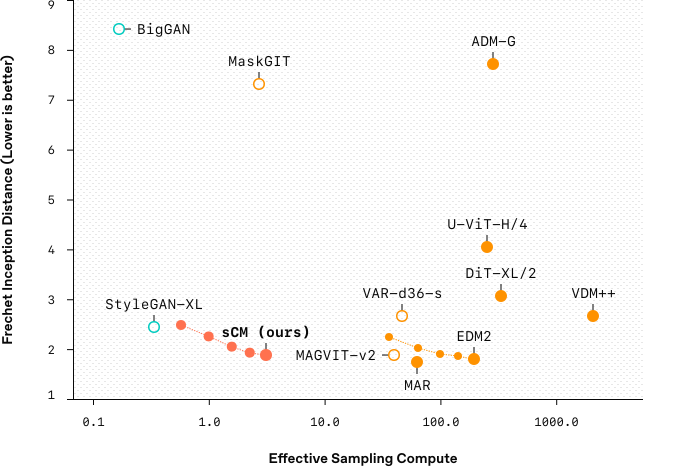
For rigorous evaluation, we benchmarked sCM against other state-of-the-art generative models by comparing both sample quality, using the standard Fréchet Inception Distance (FID) scores (where lower is better), and effective sampling compute, which estimates the total compute cost for generating each sample. As shown below, our 2-step sCM produces samples with quality comparable to the best previous methods while using less than 10% of the effective sampling compute, significantly accelerating the sampling process.
Consistency models offer a faster alternative to traditional diffusion models for generating high-quality samples. Unlike diffusion models, which generate samples gradually through a large number of denoising steps, consistency models aim to convert noise directly into noise-free samples in a single step. This difference is visualized by paths in the diagram: the blue line represents the gradual sampling process of a diffusion model, while the red curve illustrates the more direct, accelerated sampling of a consistency model. Using techniques like consistency training or consistency distillation 1,2, consistency models can be trained to generate high-quality samples with significantly fewer steps, making them appealing for practical applications that require fast generation.
Illustration on diffusion model sampling (red) and consistency model sampling (blue).
We've trained a continuous-time consistency model with 1.5B parameters on ImageNet 512x512, and provided two-step samples from this model to demonstrate its capabilities.
Our sCM distills knowledge from a pre-trained diffusion model. A key finding is that sCMs improve proportionally with the teacher diffusion model as both scale up. Specifically, the relative difference in sample quality, measured by the ratio of FID scores, remains consistent across several orders of magnitude in model sizes, causing the absolute difference in sample quality to diminish at scale. Additionally, increasing the sampling steps for sCMs further reduces the quality gap. Notably, two-step samples from sCMs are already comparable (with less than a 10% relative difference in FID scores) to samples from the teacher diffusion model, which requires hundreds of steps to generate.
FID Scaling FID Ratio Scaling
sCM scales commensurately with teacher diffusion models.
The best sCMs still rely on pre-trained diffusion models for initialization and distillation, resulting in a small but consistent gap in sample quality compared to the teacher diffusion model. Additionally, FID as a metric for sample quality has its own limitations; being close in FID scores does not always reflect actual sample quality, and vice versa. Therefore, the quality of sCMs may need to be assessed differently depending on the requirements of specific applications.
We will continue to work toward developing better generative models with both improved inference speed and sample quality. We believe these advancements will unlock new possibilities for real-time, high-quality generative AI across a wide range of domains.
1. 1 https://openai.com/index/consistency-models
2. 2 https://openai.com/index/improved-techniques-for-training-consistency-models
1. https://openai.com/index/video-generation-models-as-world-simulators
2. https://openai.com/index/dall-e-3
3. Albergo, Michael S., Nicholas M. Boffi, and Eric Vanden-Eijnden. “Stochastic interpolants: A unifying framework for flows and diffusions.” _arXiv preprint arXiv:2303.08797_ (2023).
4. Albergo, Michael S., and Eric Vanden-Eijnden. “Building normalizing flows with stochastic interpolants.” _arXiv preprint arXiv:2209.15571_ (2022).
5. Deng, Jia, et al. “ImageNet: A large-scale hierarchical image database.” _2009 IEEE conference on computer vision and pattern recognition_. Ieee, 2009.
6. Dhariwal, Prafulla, and Alexander Nichol. “Diffusion models beat GANs on image synthesis.” _Advances in neural information processing systems_ 34 (2021): 8780-8794.
7. Geng, Zhengyang, et al. “Consistency models made easy.” _arXiv preprint arXiv:2406.14548_ (2024).
8. Heek, Jonathan, Emiel Hoogeboom, and Tim Salimans. “Multistep consistency models.” _arXiv preprint arXiv:2403.06807_ (2024).
9. Ho, Jonathan, and Tim Salimans. “Classifier-free diffusion guidance.” _arXiv preprint arXiv:2207.12598_ (2022).
10. Ho, Jonathan, Ajay Jain, and Pieter Abbeel. “Denoising diffusion probabilistic models.” _Advances in neural information processing systems_ 33 (2020): 6840-6851.
11. Hoogeboom, Emiel, Jonathan Heek, and Tim Salimans. “Simple diffusion: End-to-end diffusion for high resolution images.” _International Conference on Machine Learning_. PMLR, 2023.
12. Karras, Tero, et al. “Elucidating the design space of diffusion-based generative models.” _Advances in neural information processing systems_ 35 (2022): 26565-26577.
13. Karras, Tero, et al. “Analyzing and improving the training dynamics of diffusion models.” _Proceedings of the IEEE/CVF Conference on Computer Vision and Pattern Recognition_. 2024.
14. Lipman, Yaron, et al. “Flow matching for generative modeling.” _arXiv preprint arXiv:2210.02747_ (2022).
15. Liu, Xingchao, Chengyue Gong, and Qiang Liu. “Flow straight and fast: Learning to generate and transfer data with rectified flow.” _arXiv preprint arXiv:2209.03003_ (2022).
16. Meng, Chenlin, et al. “On distillation of guided diffusion models.” _Proceedings of the IEEE/CVF Conference on Computer Vision and Pattern Recognition_. 2023.
17. Rombach, Robin, et al. “High-resolution image synthesis with latent diffusion models.” _Proceedings of the IEEE/CVF conference on computer vision and pattern recognition_. 2022.
18. Song, Yang, and Prafulla Dhariwal. “Improved techniques for training consistency models.” _arXiv preprint arXiv:2310.14189_ (2023).
19. Song, Yang, and Stefano Ermon. “Generative modeling by estimating gradients of the data distribution.” _Advances in neural information processing systems_ 32 (2019).
20. Song, Yang, et al. “Score-based generative modeling through stochastic differential equations.” _arXiv preprint arXiv:2011.13456_ (2020).
21. Song, Yang, et al. “Consistency models.” _arXiv preprint arXiv:2303.01469_ (2023).
22. Lu, Cheng, et al. “DPM-Solver: A fast ODE solver for diffusion probabilistic model sampling in around 10 steps.” _Advances in Neural Information Processing Systems_ 35 (2022): 5775-5787.
23. Lu, Cheng, et al. “DPM-Solver++: Fast solver for guided sampling of diffusion probabilistic models.” _arXiv preprint arXiv:2211.01095_ (2022).
24. Wang, Zhengyi, et al. “ProlificDreamer: High-fidelity and diverse text-to-3D generation with variational score distillation.” _Advances in Neural Information Processing Systems_ 36 (2024).
Our Research * Research Index * Research Overview * Research Residency * OpenAI for Science * Economic Research
Latest Advancements * GPT-5.3 Instant * GPT-5.3-Codex * GPT-5 * Codex
Safety * Safety Approach * Security & Privacy * Trust & Transparency
ChatGPT * Explore ChatGPT(opens in a new window) * Business * Enterprise * Education * Pricing(opens in a new window) * Download(opens in a new window)
Sora * Sora Overview * Features * Pricing * Sora log in(opens in a new window)
API Platform * Platform Overview * Pricing * API log in(opens in a new window) * Documentation(opens in a new window) * Developer Forum(opens in a new window)
For Business * Business Overview * Solutions * Contact Sales
Company * About Us * Our Charter * Foundation * Careers * Brand
Support * Help Center(opens in a new window)
More * News * Stories * Livestreams * Podcast * RSS
Terms & Policies * Terms of Use * Privacy Policy * Other Policies
(opens in a new window)(opens in a new window)(opens in a new window)(opens in a new window)(opens in a new window)(opens in a new window)(opens in a new window)
OpenAI © 2015–2026 Manage Cookies
English United States