In India, women’s innerwear is a high-frequency purchase but rarely a widely discussed category. While men’s innerwear has long enjoyed mainstream marketing and brand visibility, women’s innerwear has largely remained a functional product—widely bought but seldom designed with everyday comfort, performance, or open conversations in mind.
That gap between necessity and experience is what Krvvy is attempting to address.
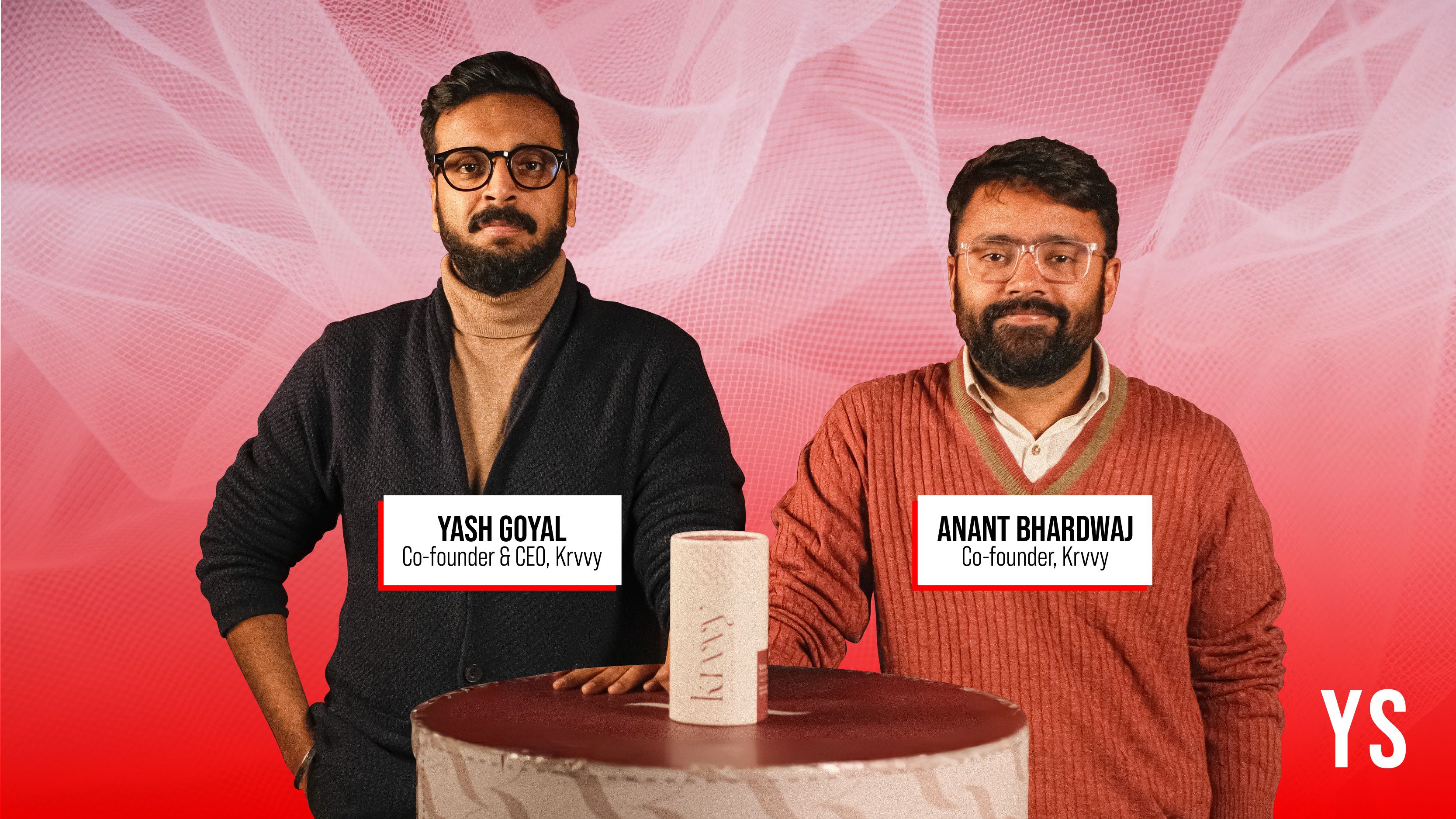
Founded by Yash Goyal and Anant Bhardwaj in May 2024, direct-to-consumer (D2C) brand Krvvy is building what it calls a “functional innerwear brand” focused on comfort, fit, and performance for Indian consumers.
“Innerwear is one of the most essential garments people wear every day, yet the category has largely been treated as purely functional,” says Goyal. “We saw a clear opportunity to build products that solve real everyday needs rather than just focusing on aesthetics or trends.”
The founders come from different professional backgrounds.
Before launching Krvvy, Goyal worked at Stride Ventures, a venture debt firm where he worked with high-growth consumer brands such as Blissclub, Bira 91, Faballey, SUGAR Cosmetics, and Neemans. His earlier roles at JPMorgan Chase and NatWest Markets focused on capital markets and financial strategy.
Bhardwaj, who leads branding and growth at Krvvy, previously worked across content and product roles. At NEWJ, a digital media venture backed by Reliance Jio, he worked on vernacular content strategies aimed at audiences in Tier II and Tier III cities. Earlier, he was a product manager at Jio.
According to Bhardwaj, those experiences shaped how the brand approaches communication in a sensitive category.
“Innerwear is often spoken about in a guarded way, but we believe it should be approached with honesty and practicality,” he says. “For us, the focus is on performance, comfort, and solving everyday problems.”
Krvvy currently offers 19 styles across four categories—shapewear, bras, underwear, and accessories. Products are available in multiple colours and sizes, with prices ranging from Rs 400 for underwear to around Rs 2,000 for shapewear and bras.
Among the brand’s best-selling products are the All Day Control Shaper, Ultrasoft Bralette, and Airsoft Boyshorts.
What differentiates the company’s product development, the founders say, is its reliance on user feedback.
“We’ve built an active focus group of women who test our products and share feedback on fit, fabric, comfort, and usability,” says Goyal. “That feedback loop directly informs our product iterations and roadmap.”
The products are designed for Indian body types and climate conditions, using fabrics such as spandex and polyamide to deliver seamless construction and targeted compression intended for all-day wear.
India’s women’s innerwear market is estimated to be worth over Rs 50,000 crore, but the founders believe there remains a gap between mass-market and premium brands.
“At one end of the market are mass brands typically priced below Rs 1,000, and at the other are global premium labels above Rs 2,000,” says Goyal. “We saw a clear whitespace in the Rs 1,000–2,000 range for an accessible yet high-quality Indian brand.”
The opportunity is particularly visible in shapewear, which has seen rapid global growth but remains relatively underdeveloped in India.
Today, shapewear accounts for about 50% of Krvvy’s revenue, while bras, underwear, and accessories contribute the rest.
Over time, the company expects bras to grow to a similar share as repeat purchases increase.
The startup says it has recorded 40x growth within its first year, driven by early product-market fit and rapid channel expansion.
After finding traction within the first few months, the company expanded distribution across marketplaces including Amazon, Myntra, Nykaa, and Ajio, while also entering quick-commerce platforms such as Blinkit, Zepto, and Instamart.
Repeat purchase rates have increased from 10% to about 30%, with demand coming not only from metro cities but also Tier II and Tier III markets.
“Shapewear has become a strong customer acquisition entry point,” says Goyal. “Once consumers experience the fabric and fit, they often return to explore other categories.”
In January 2025, Krvvy raised Rs 6.1 crore in a pre-seed round led by Titan Capital and All In Capital. The company also secured Rs 1.2 crore from Namita Thapar following its appearance on Shark Tank India earlier this year.
The raised capital is being used to expand product development, deepen category presence, and build new distribution channels.
While the brand currently operates primarily through a D2C and marketplace model, Krvvy plans to launch experiential retail stores where customers can try products before purchasing.
“Innerwear is an intimate category where many consumers still want to feel the fabric and check the fit before buying,” says Goyal. “Offline stores will help build that trust.”
Over the next 12–18 months, the company aims to grow revenues 10–15x while moving toward profitability.
The startup also plans to expand into adjacent categories such as maternity wear, nursing innerwear, period wear, and swimwear, while exploring international markets including the UAE and Southeast Asia.
For the founders, the goal is not only to scale a consumer brand but also to reshape how innerwear is designed and discussed in India.
“As a category, innerwear has always existed quietly in the background,” says Bhardwaj. “Our aim is to build products that genuinely improve everyday comfort while also normalising conversations around it.”